.png)
A Triangle in Disguise
Problem Statement
If $x,y >0$
then find the maximum value of
Solution: Of course. There is nothing interesting about the problem ,but let me show you an interesting way to solve it. In fact, I am quite chuffed to introduce you to this method. Instead, let us find the maximum value of the following.
Clearly, the given expression is:
This is what the cosine rule looks like. Of course. In a triangle in which one of the sides is $\frac{x}{2},$ the other side is $\frac{y}{3}$ and the included angle is $\theta$ and we want to maximise the side opposite the angle $\theta.$. Yet we have not answered how we get these angles to add up to theta. Look at this geometric construction
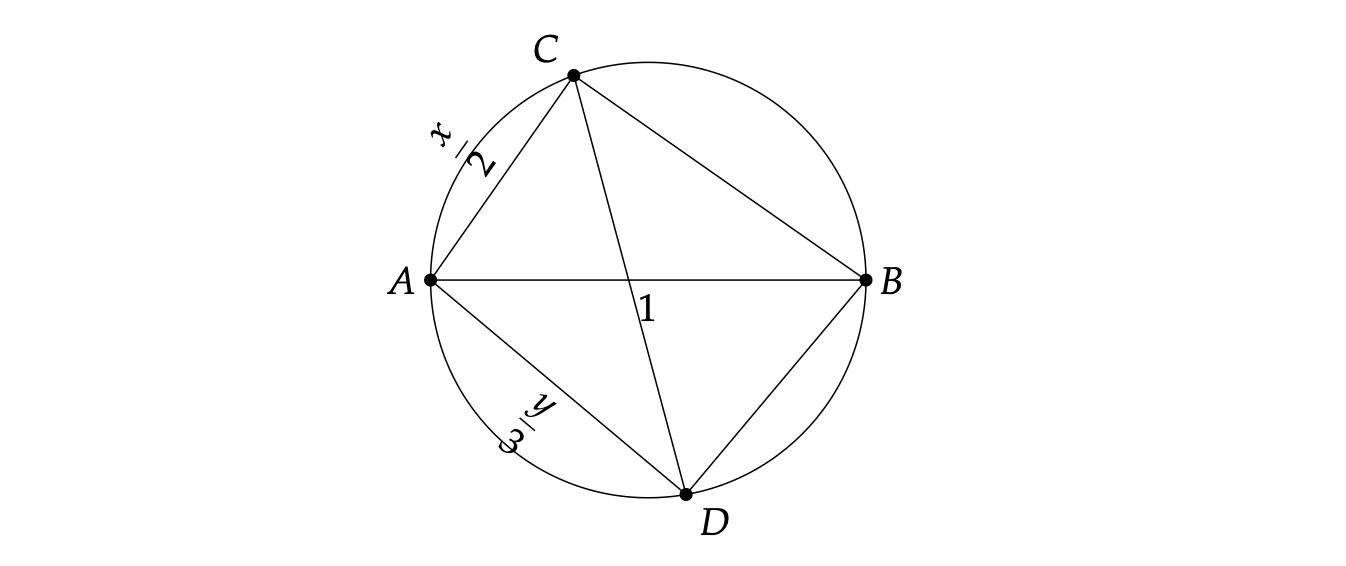
In the given diagram $ \angle CAB = \cos^{-1}(\frac{x}{2}), \angle ACB = 90^\circ, $ $AB=1, \angle DAB = \cos^{-1}(\frac{y}{3}), $ and $\angle ADB = 90^\circ. $ Since triangles $\Delta ACB$ and $\Delta ADB$ are right triangles, the required angles work. And you can see that $ \cos^{-1} \left({\frac{x}{2}} \right) + \cos^{-1} \left({\frac{y}{3}} \right) = \theta. $ Since $ \angle ACB = \angle ADB = 90^\circ, $ therefore the quadrilateral $ABCD$ is cyclic with $AB$ as a diameter of $1$ unit length. Now, in the triangle $\Delta DAC $, you can see that using the cosine rule we have to maximise $CD^2,$ which is as good as maximising $CD.$ Now $CD$ being the chord of a circle can attain a maximum value equal to $1.$ Therefore the maximum value of $CD$ and thus $CD^2$ is $1.$ Therefore,
Therefore, the maximum value of the expression is $36,$ and the equality is attained when $CD=1. $